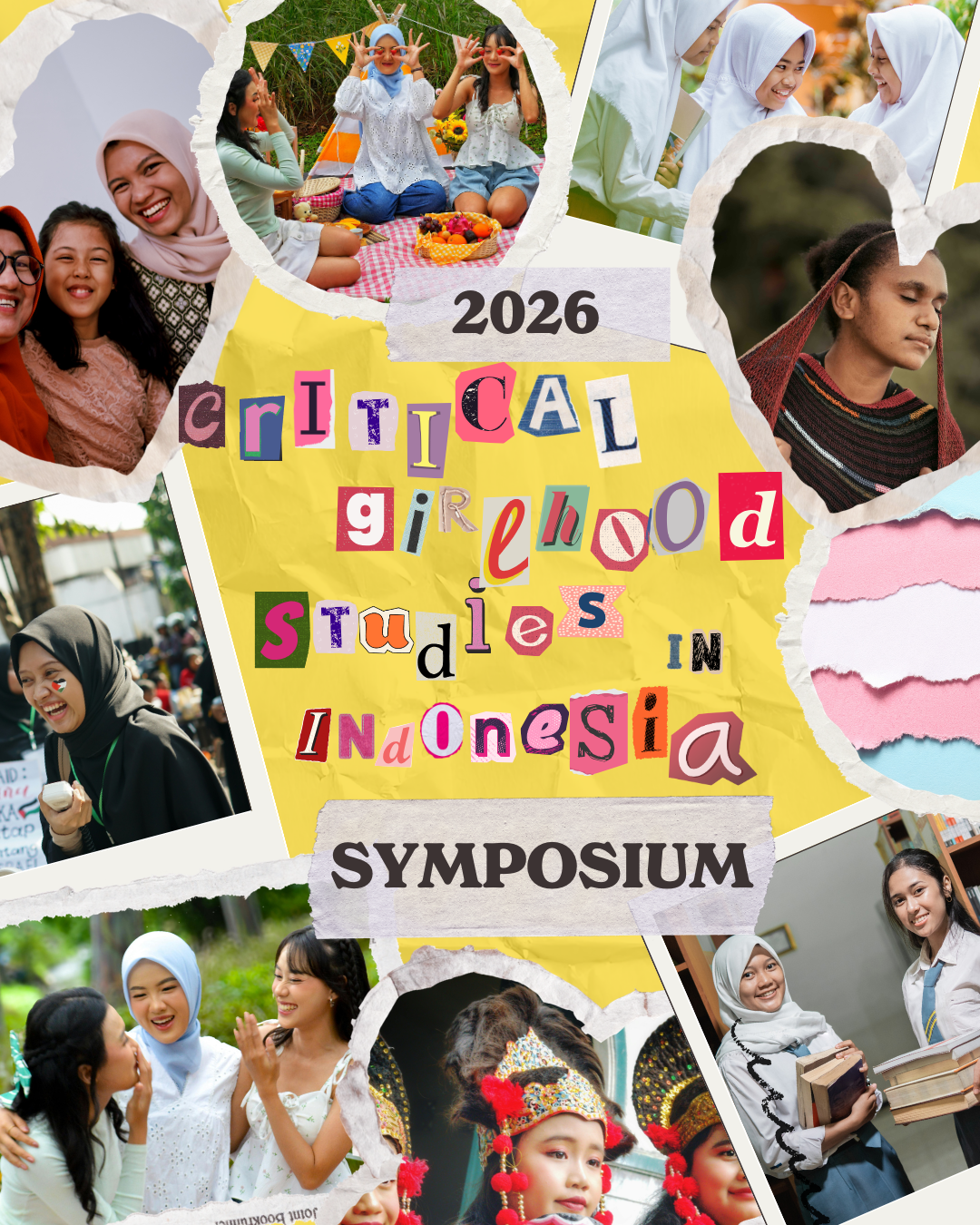
CALL FOR ABSTRACTS WILL BE CLOSED ON 4 MAY 2026❋
Call for Abstracts
Critical Girlhood Studies in Indonesia Online Symposium 2026
The online symposium invites scholars, activists, artists, educators, and community practitioners whose work engages with girls and young women in Indonesia to participate in a collective effort to advance critical girlhood studies.
Our definition of girls and young women here is inclusive and includes transgirls, young transwomen, non-binary, and other queer-identified young women and girls, and it is not bounded by a predefined age limit.
The event will serve as a space to share research, gain feedback, reflect on key challenges, exchange methods, and build networks across disciplines and sectors.
We invite extended abstract submissions from university graduate and undergraduate students, early-career researchers, emerging or community-based knowledge workers, as well as established researchers, scholars, and senior NGO practitioners. Contributors may be affiliated with a university, NGO, think-tank, community organisation, or may be working independently as researchers, activists, artists, or practitioners.
Extended abstracts should be 700-800 words and clearly outline the proposed contribution, including its focus, relevance to critical girlhood studies in Indonesia, theoretical and/or conceptual framing, methodological approach (if applicable), and its engagement with one or more of the symposium’s research agenda points.
Extended abstract criteria
Between 700-800 words
Clearly states the focus and purpose of the proposed contribution
Demonstrates relevance to critical girlhood studies in Indonesia
Outlines the theoretical and/or conceptual framework
Describes the methodological approach (if applicable)
Engages with one or more of the symposium’s research agenda points
Clarify if the abstract is practice-based, theoretical/conceptual, based on preliminary findings, or based on a completed study
Shows clarity, coherence, and strong potential for development into a full chapter
Written in Bahasa Indonesia or English
Submitted via the Google Form
The symposium will be developed into chapters for an edited volume.
Presentation and abstract submissions may be in Bahasa Indonesia or English. Each presentation in the symposium is expected to be 15 minutes long.
After the symposium, selected contributors will prepare their full chapters in English for inclusion in the edited volume. We expect each chapter to be 5,000-6,000 words. Chapters can be co-authored.
Shifting the Paradigm
Both the symposium and the edited volume extend the research agenda set out in “Shifting the Paradigm: Rethinking Research on Indonesian Girls and Young Women” (Beta, Gummay, Nisa, Tieken and Adhi, 2025).
We invite you to read the article “Shifting the Paradigm” prior to submitting your extended abstract, as it provides important context for the conceptual and critical orientation of this symposium and the resulting edited volume.
If you do not have access to the article, please contact the co-convenors (Annisa & Tania) via email at annisa.beta@unimelb.edu.au and pritania.astari@student.unimelb.edu.au
Symposium Agenda Points
Contributing papers to this symposium and edited volume are invited to work with the following agenda points in shaping their chapters. Authors should draw on one or more of the following points and are encouraged to combine them in ways that allow their work to meaningfully contribute to the innovation, strengthening, and re-centring of critical girlhood studies in Indonesia:
Critical examinations of sexual and reproductive healthcare discourses, methods, and stigma: Explore how online and offline health narratives, public health research approaches, and institutional healthcare practices shape the experiences of girls, transgirls, young women, young transwomen, and non binary people. Contributions may analyse stigmatising digital health content and influencer cultures, interrogate dominant public health methodologies and evidence frameworks, and examine lived encounters with biomedical and psychological care. The theme invites work that moves between media analysis, critical public health, and feminist girlhood studies to rethink safer, accountable, and inclusive SRHR knowledge and care practices.
Reproductive justice in health research with young women: Moving beyond the Sexual and Reproductive Health and Rights (SRHR) framework, the application of the Reproductive Justice framework in health research seeks to re-examine issues such as unintended pregnancy, safe abortion, contraception, and adolescent parenting through the lens of young women’s rights: (1) to have children, (2) not to have children, and (3) to parent children in safe and healthy environments free from violence. Contributions may explore how young women from marginalised communities, including gender-diverse women, negotiate and exercise their reproductive rights both individually and collectively. The theme invites work that foregrounds lived experiences, structural inequalities, and collective strategies of resistance in advancing reproductive justice.
Decolonial and feminist rethinking of Indonesian girlhood: Critically interrogate dominant academic, policy, NGO, and media narratives that frame girls through risk, morality, and vulnerability. Contributions may challenge deficit based framings by foregrounding relational, contextual, and intersectional understandings of girlhood, attending to differences of class, religion, ethnicity, region, disability, gender expression, sexuality, migration status, and other lived conditions. The theme invites work that centres girls’ embodied knowledges, affective experiences, and everyday meanings as legitimate sources of theory and critique.
Participatory methodologies, ethical innovation, and interdisciplinary knowledge practices: Explore methodological redesign through participatory, youth led, and culturally situated research practices that position girls as co-researchers. This theme welcomes feminist and decolonial critiques of knowledge production, reflections on care based research ethics and accountability, and interdisciplinary approaches that move beyond single discipline paradigms or narrowly biomedical framings to rethink how girlhood studies is produced and circulated.
Institutions, infrastructures, and economic empowerment: Examine how schools, higher education institutions, religious organisations, platforms, state policies, NGOs/non-profits, families, and corporate systems regulate or enable girls’ lives, while also attending to the institutional infrastructures that shape these environments. Contributions may interrogate entrepreneurialism and economic empowerment programmes for girls, asking how such initiatives make common neoliberal logics of self optimisation, productivity, and individual resilience, and how they intersect with classed, racialised, and religious formations of girlhood in Indonesia. This theme encourages analyses that situate empowerment within political economy, labour regimes, and/or platform capitalism. It may foreground how girls negotiate, appropriates, or refuse institutional demands.
Digital worlds shaping girlhood: Contributions may analyse girls’ engagements with digital media, fandoms, gaming, and/or messaging platforms as sites of political imagination, creativity, resistance, and community building. Rather than treating digital spaces as either risk or empowerment, this theme invites work that examines platform governance, algorithmic visibility, data extraction, surveillance, labour, and digital intimacy, alongside girls relational practices online. We encourage contributions to situate digital girlhood within Indonesian media ecologies and transnational flows, attending to linguistic, religious, regional, and class differences and similarities structuring participation or exclusion.
Everyday solidarities, feminist knowledge practices, and alternative futures: Attend to ordinary and often invisible practices through which girls sustain friendships, care for others, and imagine different futures. This theme invites work on girl led forms of knowledge translation and circulation, including zines, videos, podcasts, exhibitions, performances, online campaigns, social media practices, and collective organising, foregrounding how dissemination itself becomes a site of feminist practice rather than a final stage of research.
Institutional transformation, transnational collaboration, and reflexive educational practices: Examine how critical girlhood studies intervenes in school curricula, university teaching, community programmes, and policymaking while building sustained transnational networks among researchers, activists, artists, and young women. Contributions may also reflect on reflexive and accountable research practices that attend to positionality, power, emotion, and complicity, positioning self critique as an ongoing methodological commitment within collaborative institutional work.
Important dates
Call for abstracts deadline: 4 May 2026
Announcement of selected abstract: 8 June 2026
Online symposium: 13 July 2026
Submission of full paper for selected presenters (5-6000 words, in English or bahasa Indonesia): 12 October 2026