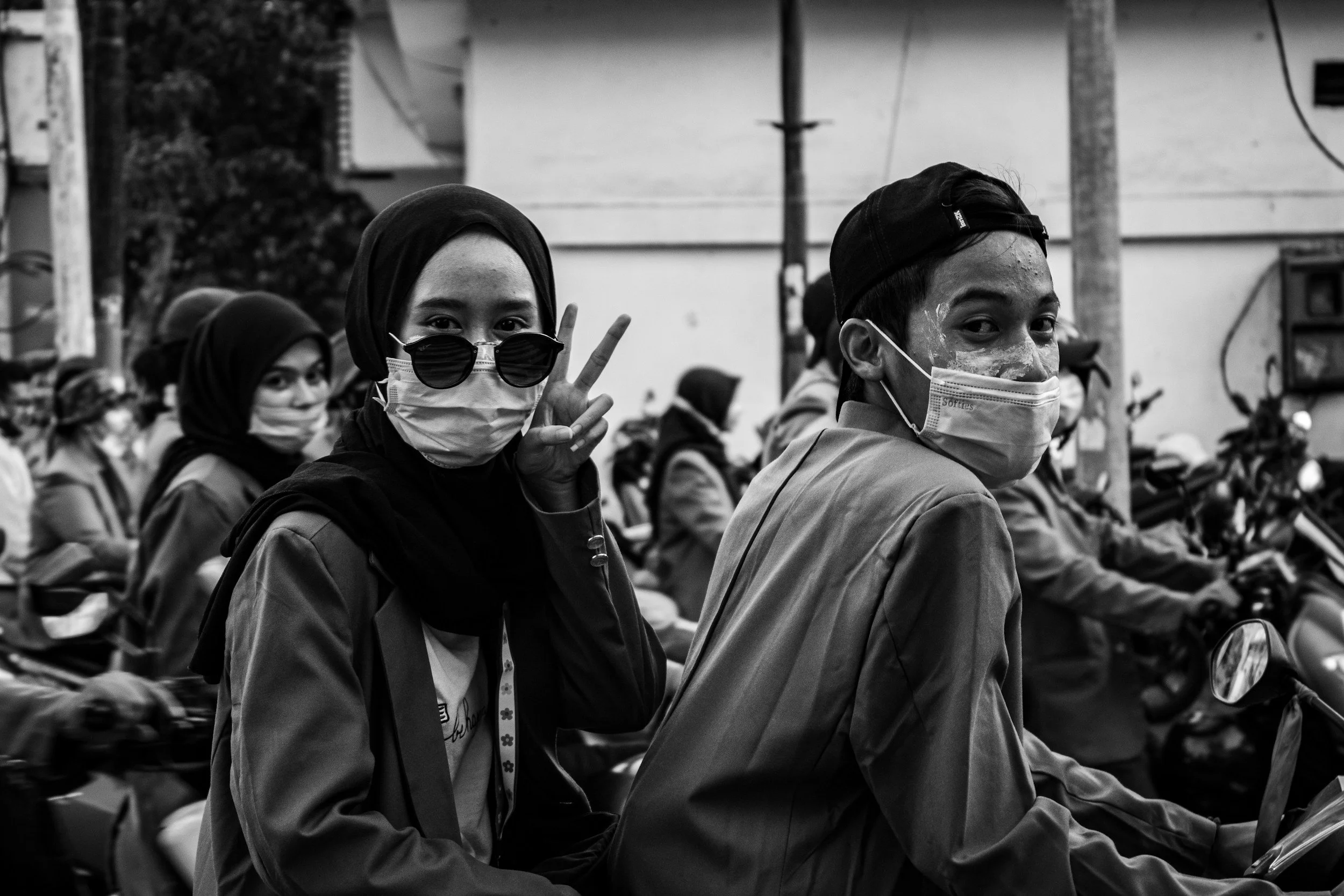
Photo by Hobi industri on Unsplash
Co-convenors
Dr Clara Siagian (University College London, c.siagian [at] ucl.ac.uk)
Dr Annisa R. Beta (University of Melbourne, annisa.beta [at] unimelb.edu.au)
Important dates
Event date: 24 June 2026, University of Melbourne Parkville Campus, Naarm/Melbourne
[closed] Extended abstract submission: due 6th April submitted via Google Form
Selected abstract announced on 13th April
Short draft (3000-4000 words inclusive of captions, figures, and references): 30 May 2026, only authors of selected abstracts will be invited to submit a draft.
Update (April 2026): We have selected participants for the symposium. Due to the high level of enthusiasm from the research community, we are also organising an online symposium in October 2026. Details will follow.
This symposium invites scholars working on youth cultures, politics, and public life in Southeast Asia to engage in a one-day intensive discussion on how young people living in and from Southeast Asia navigate constrained political, economic, and cultural environments across the region.
Convening early- and mid-career researchers as well as graduate students from different disciplines, the symposium fosters interdisciplinary and comparative conversations on young people as social actors living within rapidly shifting state-society relations.
Across the Southeast Asian region, young people encounter a shared landscape marked by democratic regression, economic precarity, expanding informal and gig economies, climate vulnerability, geopolitical tension, and intensifying political surveillance and suppression. At the same time, youth continue to be mobilised discursively as symbols of nationalistic futures, demographic dividends, and catalysts for revolutionary political transformation. This tension between expectation and constraint constructs how young people articulate belonging, aspiration, dissent, and everyday survival.
Distinct political cultures, historical trajectories, and economic and social infrastructures shape how young people in Southeast Asian societies perceive and navigate their social, cultural, and political positioning. Despite many overlapping conditions, youth experiences across the region are uneven. Youth mobilisations shape public debates in Indonesia, Thailand, Malaysia, and the Philippines (Sastramidjaja, 2025). In Myanmar, young people sustain resistance amid acute violence (Prasse-Freeman, 2023), whereas in Vietnam, young people’s increasing political participation expands through digital media but remains shaped by political constraints (Le et al., 2024). In Cambodia, Brunei, Laos, and Singapore, youth participation is frequently expressed through state-led or institutionalised frameworks (Mohamad, 2023; Sim & Chow, 2020; Sisaath et al., 2025; Vong, 2022). Timor-Leste presents another configuration where young people’s participation is intertwined with processes of social transition, identity formation, and cultural negotiation shaped by the post-conflict dynamic (Jesus, 2024).
As one of the most digitally connected regions, Southeast Asia’s digital spaces function as critical terrains of civic experimentation and intensified surveillance (Abidin & Pang, 2025; Lim, 2024). The digital landscapes and social media cultures are crucial sites through which Southeast Asian young people generate exciting cultural expressions and new political grammars and solidarities. Short-form videos, memes, fandom cultures, and pop culture references circulate and are playfully remixed across borders, enabling young people to articulate precarity, critique authority, and build transnational publics. Recent phenomena such as the Milk Tea Alliance or the circulation of One Piece anime symbols in youth-led protests illustrate how cultural forms can operate as political vocabularies legible across linguistic and national differences.
This symposium invites works that approach young people as active subjects embedded in cultural practices, infrastructures, and power relations, not merely as a demographic category or policy target. We welcome contributions that examine how youth produce meaning, negotiate authority, and reimagine public life and political culture through everyday practices, digital and social media cultures, artistic and creative expressions, diverse forms of activism, or institutional engagement under multiple constraints. Papers can address local case studies or multinational comparisons and draw on methodologies from sociology, geography, anthropology, political science, education, cultural studies, urban studies, media studies, development studies, and related fields.
The symposium is designed as an intensive and collaborative event. Participants are expected to submit near-finished drafts in advance and engage in structured discussions and collective reflections. They will also discuss editorial planning toward potential publication outputs, including, but not limited to, a special issue in a journal (e.g., Critical Asian Studies, Modern Asian Studies) and an online magazine special edition (e.g., New Naratif, New Mandala).
We have secured strong participation from invited scholars working on Indonesia. To support broader regional representation, we particularly welcome submissions that engage other Southeast Asian contexts.
The symposium will be organised at the University of Melbourne’s Parkville campus, Australia, with the possibility of online attendance for a limited number of participants. Unfortunately, we cannot provide financial support for travel or lodging. Participants attending the symposium in person will need to arrange their own travel and lodging.
Tentative Agenda
All times are in Australian Eastern Daylight Saving Time (AEDT):
09.30–10.00
Morning tea and informal chat10.00–10.30
Opening and Welcome to CountryRationale and objectives of the symposium by the co-convenors
Round of introductions among participants
10.30–11.30
Critical intervention [TBC]11.30–12.30
Group workshop
Presentation and discussion in small groups. Co-convenors will assign discussants prior to the symposium.12.30–13.45
Lunch break13.45–14.45
Group workshop (continued)14.45–16.00
Panel discussion
Each group presents key highlights from their discussion, focusing on emerging themes, cross-cutting insights, divergences, and convergences.16.00–16.30
Afternoon tea16.30–17.30
Panel discussion
Moving forward with the special issue: themes, contributions, potential outlets or journals, formats, and timeline.
References
Abidin, C., & Pang, N. (Eds.). (2025). Internet popular culture and (everyday) politics: Methodological & ethical critiques from Southeast Asia (1st ed.). Routledge. https://doi.org/10.4324/9781003619369
Jesus, A. de. (2024). Youth Transition, Culture and Identity in Timor-Leste. Diálogos, 9, 147–163.https://doi.org/10.53930/27892182.dialogos.9.147
Le, V. T., Ly-Le, T.-M., & Ha, L. (2024). Social Media and Political Participation in Vietnam: Disrupting Journalism in the Virtual Public Sphere (Vol. 10). Springer Nature.https://doi.org/10.1007/978-981-97-8955-9
Lim, M. (2024). Social Media and Politics in Southeast Asia. Cambridge University Press.https://www.cambridge.org/core/elements/social-media-and-politics-in-southeast-asia/C9162DC3D2D71484FB0F640A6E61A2DA
Mohamad, S. M. (2023). The ‘Future-Ready Youth’ of Brunei Darussalam: Meeting National Aspirations through Digital Civic Engagement. Perspective, (2023 No. 3), 1–8. https://www.iseas.edu.sg/wp-content/uploads/2022/11/ISEAS_Perspective_2023_3.pdf
Prasse-Freeman, E. (2023). Bullets and Boomerangs: Proleptic Uses of Failure in Myanmar’s Anti-coup Uprising. Public Culture, 35(1 (99)), 73–112.https://doi.org/10.1215/08992363-10202416
Sastramidjaja, Y. (2025). Connective spaces of radical hope: rhizomatic youth struggles for viable futures in Southeast Asia. Journal of Youth Studies, 28(6), 867–884. https://doi.org/10.1080/13676261.2025.2556927
Sim, J. B.-Y., & Chow, L.-T. (2020). The Development of Civic Participation Among Youth in Singapore. In A. Peterson, G. Stahl, & H. Soong (Eds.), The Palgrave Handbook of Citizenship and Education (pp. 759–777). Palgrave Macmillan, Cham.https://doi.org/10.1007/978-3-319-67828-3_8
Sisaath, S., Mai, A. N., & Keohavong, B. (2025). Professional development and youth unions: An organizational effectiveness assessment in Luang Prabang, Laos. Thai Man and Society Review, 1(1), 1–16.https://doi.org/10.14456/tmsr.2025.5
Vong, M. (2022) State Mobilization in Authoritarian Regimes: Youth Politics and Regime Legitimation in Cambodia. Journal of East Asian Studies. 22(3), 411-434. https://doi.org/10.1017/jea.2022.18